A delegation of U.S. medical supply clients visited Wehere Medical's Hangzhou headquarters on 29 October 2026 for a focused working session on wound care solutions - and specifically on what is coming next in new product development. The visit covered our wound dressing portfolio, the engineering and sterilization capabilities behind it, and the pipeline we are building for 2027.
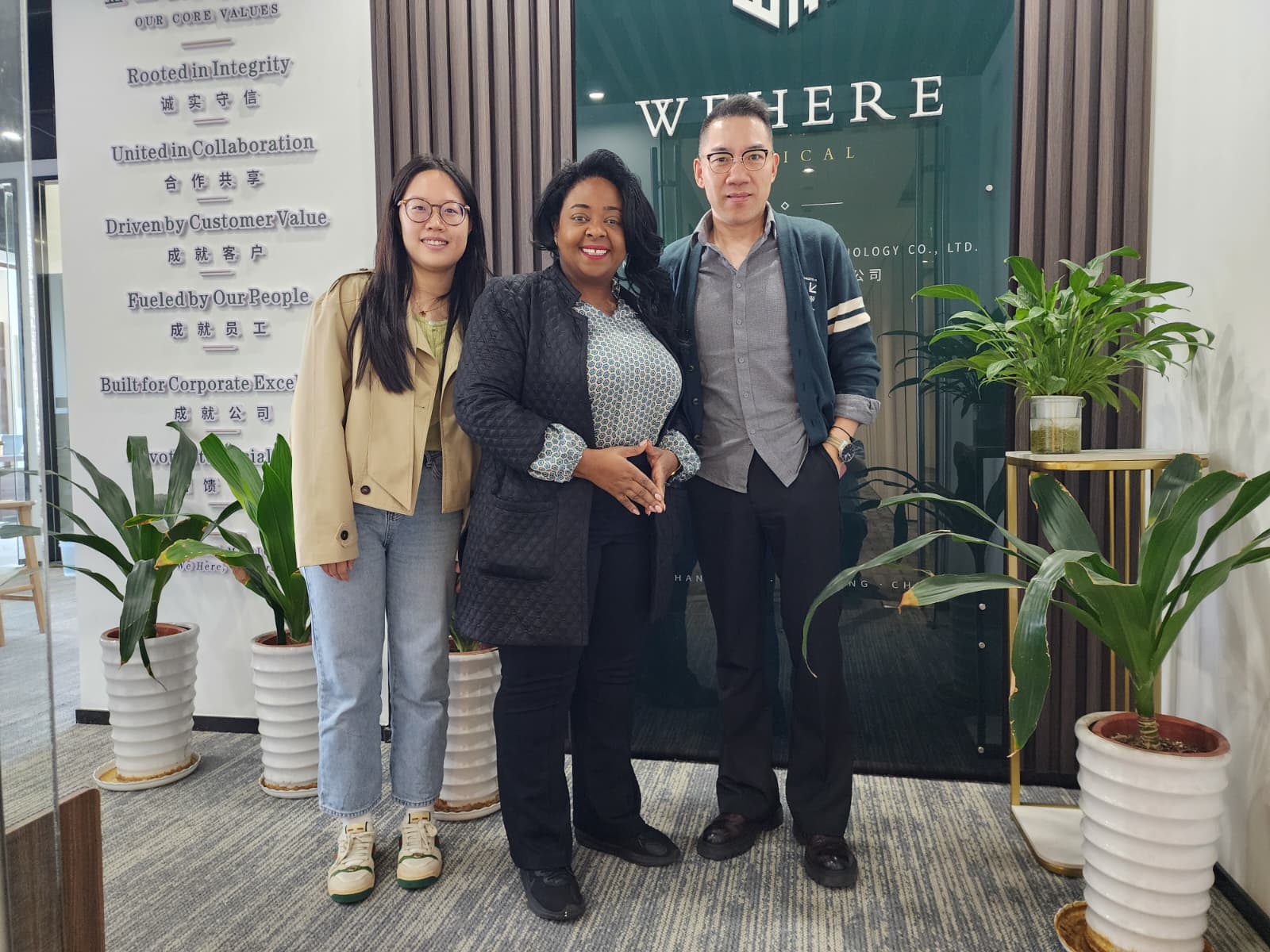
U.S. client delegation with the Wehere Medical team at the company reception area in Hangzhou, 29 October 2026.
What the client wanted to understand
The delegation's questions were practical rather than general. Rather than reviewing an existing catalogue, the group asked how we move a wound care concept from specification to a shippable, sterilised, documented product in a realistic timeline. The conversation centred on four areas:
- Material and construction choices. Which dressing constructions hold up under real clinical conditions - exudate handling, edge adhesion, conformability over high-mobility joints, and how the dressing behaves through a full wear cycle rather than just the first hour.
- New product development workflow. How a new SKU moves through our pipeline: specification lock, sample approval, biocompatibility and packaging testing, sterilization routing, and the documentation package needed for both FDA and EU MDR markets.
- Private label and OEM readiness. Whether product development can be structured around a buyer's own brand, from artwork and carton design through to unit pricing and shipping configuration.
- Scale and supply assurance. How a validated wound care product is supported across production volume, raw material continuity, and quality documentation that holds up under customer or regulatory review.
Our approach to wound care development
Wound care is one of the areas where the gap between a promising sample and a reliable commercial product is widest. A dressing can perform beautifully in a lab and still fail in practice - poor adhesive release, fraying at the edges of the pad, inconsistent absorbency across a production batch, packaging that tears in a shipping carton. Those are precisely the failure modes our development team is built to close.
We walked the delegation through our wound care production flow, from raw material inspection through to the finished, sterilised, cased product ready for export. Rather than presenting a slide deck, we brought the team into the production area so that each step could be asked about directly - which is where the useful details usually surface. Questions about batch consistency, change control and how a customer-approved specification is locked and preserved over time were answered at the machines, not at a conference table.
From discussion to development agreement
The visit concluded with a concrete development brief rather than a general expression of interest. The delegation's product requirements were recorded in detail, including the target indications, the wear-time expectations, and the documentation package required for their own regulatory filings. Our engineering and quality teams will now develop the initial samples against that brief, with a structured review scheduled before the first quotation is issued.
Más de 25 años de experiencia en fabricación · 3 fábricas propias + 45 fábricas de socios auditadas · Más de 2 500 líneas de producto · Exportaciones a más de 50 países · Sistemas de calidad alineados con ISO 13485 y el MDR de la UE · Respuesta a consultas en 24 horas.
If you are planning a wound care product development program, we can host a similar technical visit, or start with a specification discussion and a sample proposal. Contact us to arrange it, or browse our wound care and surgical dressings ranges.